
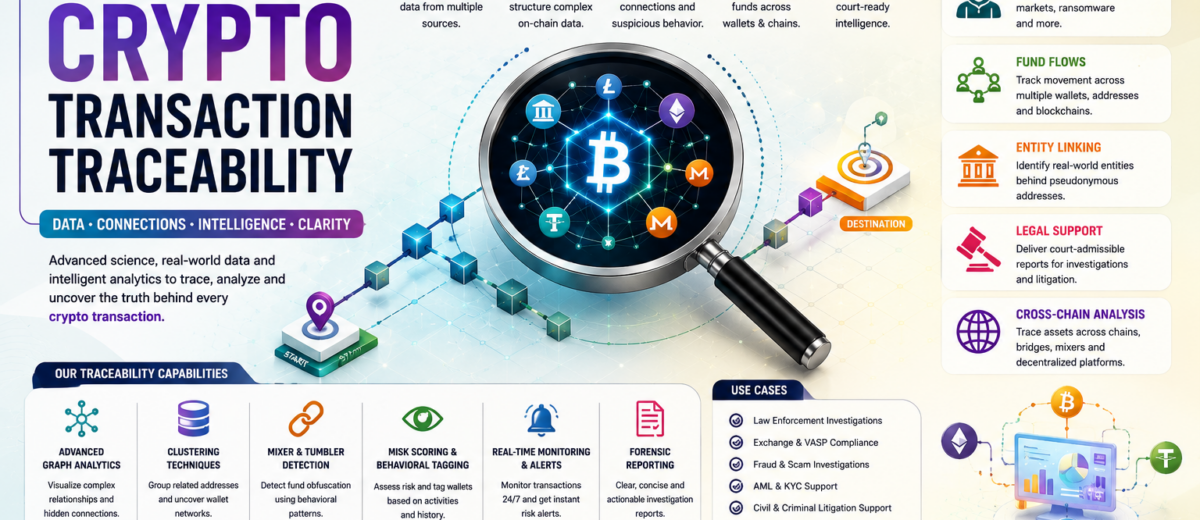
To trace crypto transactions the public blockchains need to operate as open digital ledgers. Each payment permanently records the wallet addresses, time of transfer and amount of transfer. At this point the specialized forensic tools analyze these patterns and crosscheck them with crypto exchange identity checks with public data, mapping transactions and identifying real world owners.
Introduction
Many people think of cryptocurrency as something invisible or like digital cash changing hands in the shadows. But the reality is quite the opposite of this. Most popular cryptos run on public ledgers where every single transaction is forever recorded and viewable by anyone with an internet access. To help you picture a blockchain first think of a large glass piggy bank in the middle of a busy town square. Everyone can see all transactions, all the money in and out of the account, and the exact time and amount of each transaction.What people don’t see immediately is the name on the face of the account holder. That is where the science of crypto traceability comes in. Investigators can stitch together digital footprints by looking at patterns, relationships and real world contact points. Public blockchains are not a wild west of untraceability. In fact they are one of the most transparent financial trails ever created.
Contents
The mechanics of Blockchain Transparency
How Forensics Link Wallet Addresses to Real Identities
Comparison Table
Real World Case Example
Tip
Mistakes commonly made
FAQs
Summary
The Mechanics of Blockchain Transparency
If you want to understand how crypto tracing works, you need to first look under the hood of a blockchain. When you send a cryptocurrency to a friend you are not sending a file. Instead you are sending a message to a worldwide network of computers saying “Move this amount from Wallet A to Wallet B. Once your transaction is verified by the network it is added to other transactions to create a new block of data for the ledger. All this information is stored on thousands of computers simultaneously making it nearly impossible to change or delete what has already occurred. Every transfer holds three pieces of important information . The address of the sender , the address of the receiver and the exact amount transferred. Cryptocurrency is pseudonymous not anonymous. That is because public wallet addresses are long strings of letters and numbers & not human names. Think of a wallet address like a username on a message board. Even if it is not your real name then also every post you make is tied to that same username.
As you use that address over time you build up a unique digital signature. Blockchain analytics software traces those signatures through millions of transactions and clusters related addresses. Investigators are able to track the flow of funds between wallets, identify activity hubs, detect abnormal activity and trace the flow of funds from source to destination in a step by step manner.
Forensic investigators and linking wallet addresses to real-world identities
Half the battle is knowing that funds have moved from one alphanumeric address to another. The real science of traceability is bridge building and linking anonymous digital addresses to real people. This process leverages advanced data analytics, heuristic clustering and regulatory identity checkpoints. Heuristic clustering is a bit like being a digital Sherlock Holmes. Software algorithms say all those input and output addresses probably belong to the same person or entity if a user opens up a crypto wallet and sends small amounts to five different addresses in one transaction. These algorithms over time transform tangled webs into neat visual networks.
Usually the last piece of the puzzle happens on centralized cryptocurrency exchanges. If someone wants to convert their crypto into real world money such as dollars or euros they must go through Know Your Customer (KYC) identity checks. Exchanges require users to upload government IDs and proof of address before they can transfer funds to a traditional bank account. If blockchain analytics programs can follow a trail of illicit or lost funds to an exchange wallet then investigators can hit that platform with a legal subpoena. The exchange then closes the loop between the virtual ledger and the physical world by giving the real name, IP address and bank details linked to that wallet.
Comparison Table
| Feature | Public Blockchains | Privacy Coins | Traditional Banking | Physical Cash |
| Ledger Visibility | Anyone can view transactions | Encrypted Hidden inputs, outputs, & amounts | Controlled by financial institutions | No ledger exists |
| Identity Link | Pseudonymous | Anonymous | Directly Linked(Account holder name) | Anonymous |
| Traceability Level | Permanent | Low to Complex | Accessible via court order | Untraceable once spent |
| Primary Tracing Method | Blockchain analytics & heuristic clustering | Network level analysis & cash-out endpoints | Internal bank logs & SWIFT tracking | Serial number tracking |
| Regulatory Compliance | High (Travel Rule, Exchange KYC) | Banned on many exchanges | Full (AML / KYC standard) | Regulated cash limits |
Real World Case Example
Imagine a hacker stealing cryptocurrency from an online wallet and then trying to cover their tracks. They use a number of temporary addresses to send the money so as to confuse onlookers. Forensic software, however, tracks the entire movement in real time monitoring the funds as they pass through six separate wallets. Finally the hacker tries to move the stolen crypto to a popular exchange so they can buy real stuff. The source address was marked as stolen so the exchange’s automated monitoring system throws up a red flag on the incoming deposit. The account is immediately frozen and the authorities use the KYC registration details of the hacker to recover the funds and identify the individual at crypto-investigation.
Tip
Remember that your public wallet activity is forever visible to the world. If you are a real person who cares about personal privacy then you have to separate your daily transaction wallets from long term storage accounts. One should not post the primary wallet address on the social media platforms as it may create a huge blunder for the person.
Mistakes commonly made
- Thinking crypto is totally anonymous: Assuming alphanumeric addresses mask your real identity for all time.
- If mixing services make you invisible: Crypto mixers are supposed to hide funds when in modern heuristics they are routinely traced through. When you use the same wallet address everywhere all of your financial habits and online activity are tied to a single public key.
- Not knowing about exchange KYC rules: Not realizing that converting crypto into cash requires formal identity checks.
- Publishing wallet addresses: Publishing your public keys on social channels associating your real name with your ledger.
- IP address leak exposure: Using insecure network connections for wallet transactions.
FAQ
Is Bitcoin transactions traceable by the police department ?
Yes. Using specialist blockchain analytics software, law enforcement agencies routinely keep an eye on Bitcoin transactions. Because the Bitcoin system is based on a transparent public record, investigators can track the movement of funds indefinitely between wallet addresses. When those funds hit a regulated exchange that requires identity verification authorities can connect the digital movement to a real person in the real world at dark-web-wallet.
What is the difference between pseudonymous and anonymous in crypto?
Pseudonymous is when you go by a consistent alias rather than your real name. Your wallet address is your crypto alias. All your transactions can be seen under that address. Anonymous in contrast means no visible record or identifier at all. Cash is anonymous but public cryptocurrencies are pseudonymous as all the transactions on a public address are visible.
Can crypto mixers be profitably untraceable?
Crypto mixers combine transactions of different users to make it harder to track the source of the money but they do not guarantee total anonymity. Modern forensic analytics use sophisticated clustering and machine learning to analyze the timing, amounts and network behavior. Funds can often be traced through mixing services over time especially when combined with off-chain intelligence and exchange checkpoints that investigators have found.
How do analytics companies track crypto transactions?
Analytics companies scrape and index public blockchain data across multiple networks. Algorithms are used to connect related wallet addresses together based on spending behavior and transaction structures. They also tag known addresses for exchanges, darknet markets and scams to map complex financial trails and clearly highlight high risk money movements.
How do crypto exchanges help trace transactions?
Exchanges are a key link between crypto and traditional banking. Regulated exchanges are required by KYC laws to collect personal details such as names, addresses and copies of IDs. If blockchain tracing leads to an exchange account, law enforcement agencies can send legal requests to find out who the person behind those traced funds is at cryptocurrency-investigation-services.
Is public tracing of crypto bad for individual privacy?
Not necessarily but depends on how it is dealt with. Public traceability is a crime and money laundering deterrent, but it is a threat to ordinary personal privacy. Anyone who knows your wallet address can view your balance and transaction history. Good privacy management means teaching users about privacy and keeping separate wallets for separate activities.
What is heuristic analysis in blockchain forensics?
Heuristic analysis is where you use rule based algorithms to infer relationships between wallet addresses. If a transaction uses multiple input addresses to make a single payment, heuristics assume one owner controls all those inputs. These clever assumptions allow forensic tools to group thousands of disparate addresses into unique, manageable clusters owned by single entities.
Summary
One of the biggest misconceptions in modern finance is that cryptocurrency is a shadow economy that cannot be traced. Public blockchains are in fact the ultimate record books, the record books that are always available for everyone to see. The transparency of the ledger, coupled with forensic analytics and the verification of exchange identities, means that crypto leaves an unusually clear paper trail. Knowing the science of how transactions are traceable demystifies the real workings of digital resources. Whether you are an everyday investor and a curious onlooker or a business looking into digital payments then understanding that digital footprints are permanent will help you to navigate the space safely and responsibly.