
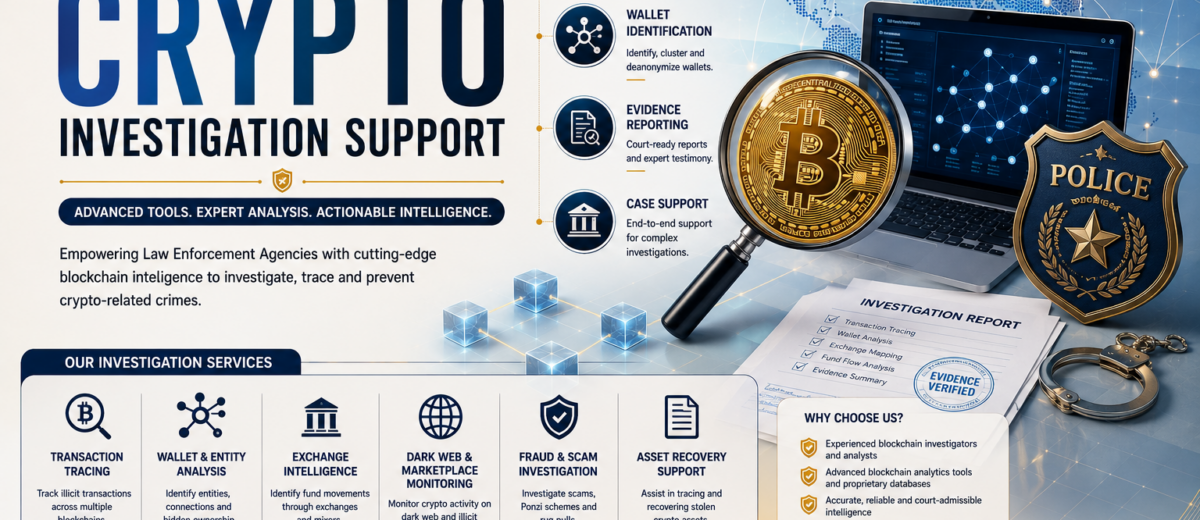
Law enforcement crypto investigation helps the government department and police to track the stolen cryptocurrency. They use specialised softwares and products that traces funds across the complex blockchains, reveal the real culprit and anonymous wallet owners and also prepare evidence to catch cybercriminals and recover assets.
Introduction
The use of cryptocurrency has changed the face of digital finance, but has also created unprecedented investigative challenges for law enforcement. Money laundering, ransomware extortion, darknet illicit trades and investment scams are increasingly being conducted by criminal syndicates using decentralized networks, privacy currencies, cross-chain bridges and mixing services. Conventional financial surveillance methods are not sufficient for tracking pseudo-anonymous on-chain transactions across borders.
This operational gap can be closed by law enforcement officers, investigators and prosecutors using specialized law enforcement crypto investigative support that equips them with the necessary tools and domain knowledge to solve on-chain crimes. Investigative support services blend cutting edge blockchain intelligence technologies with specialized forensic analysis and legal subpoena methods to turn raw transactional data into actionable leads and admissible evidence in court.
Today, law enforcement agencies rely on private intelligence partners and specialized crypto support units to trace stolen funds, identify criminal groups and conduct asset seizures. In this comprehensive guide, we will explore the critical techniques, technology stacks and proven strategies that empower today’s law enforcement to effectively combat blockchain-enabled criminality.
Content
Introduction
Main Elements of Crypto Investigation Support Methods
Comparing Internal Research to Outside Expert Help
A Real World Example
Expert advice to police officers
Common Mistakes in Crypto Research
FAQ
Summary
Key Elements of Crypto Investigation Support
Law enforcement crypto investigation support is a complete suite of specialized tools, intelligence services and technological know-how to support law enforcement agencies through all stages of a digital asset investigation. Crypto investigation support essentially provides the specialized infrastructure that is required to manage transparent but highly complex distributed ledger systems.
The advanced blockchain analytics and visualization software is a key part of this support. Top intelligence services offer tools to investigators to map transaction flows, group similar wallet addresses into identifiable entities and track movement across hundreds of different blockchains and decentralized finance protocols. Rather than manually parsing cryptographic hash data, investigators utilize visual graph nodes that depict how money flows from victim wallets to illicit destinations.
Specialized crypto support provides hands-on help with real-world cases and professional advice, beyond software subscriptions. Sophisticated demixing analysis, cross-chain swap monitoring and complex smart contract interaction decryption can be performed by skilled forensic analysts to aid law enforcement. This intelligence is key when dealing with advanced threat actors who deliberately launder funds using privacy enhancing technologies like coin join mixers, dynamic token bridges or decentralized exchanges.
Support for investigations helps law enforcement agencies serve subpoenas and perform legal attribution operations. Blockchain ledgers show the flow of money, but to identify the true person behind a wallet address, it is necessary to connect on-chain information to off-chain identification records. Support professionals assist with the preparation of accurate legal process documents for Virtual Asset Service Providers (VASPs) so that law enforcement can access bank account information, IP logs, and Know Your Customer (KYC) records held by centralized cryptocurrency exchanges. Finally, specialist support teams help generate defensible forensic findings and provide expert witness testimony in court to ensure that seized digital files remain legally secure.
Techniques for spotting illicit on-chain activity
To discover illegal activity on the blockchain, structured approaches that combine raw technical data with standard law enforcement investigation techniques are necessary. The first step in the investigative process is usually the analysis of transaction flows. Detectives follow the flow of illicit money from the first point of compromise (e.g. a phishing address or ransomware payment wallet) downstream through a chain of digital transactions.
Support professionals use two major techniques: entity clustering and behavioral heuristics. Blockchain analytics systems use deterministic algorithms and behavioral patterns to aggregate thousands of different wallet addresses into a single controlling organization. Shared input heuristic, shifting address pattern, and co-spending behavior allows investigators to identify if an address is connected to a specific suspect, a darknet marketplace, a ransomware strain or a certain centralized exchange.
“One of the most important aspects of assisting in crypto investigations is to identify cash-out chokepoints. Eventually, the cybercriminals need to move digital possessions to buying channels or cash out into fiat money. The investigation support teams concentrate on tracking money until it reaches crypto ATMs or centralized Virtual Asset Service Providers (VASPs) that enforce anti-money laundering laws. When money lands in an exchange deposit address, investigators can use search warrants, emergency preservation letters or freeze orders to stop further movement of assets.
Today, bridge analysis and cross-chain tracing are central to law enforcement operations. Criminals will often exchange tokens between different blockchains, such as Ethereum to Bitcoin or Tether, to avoid the linear trail of custody. Cross-chain graphing engines can be employed by specialized investigative support to trace asset trails through automated bridges and liquidity pools. By combining automated monitoring alerts with specific off-chain intelligence, law enforcement organizations will be able to track threat actors across complex web3 ecosystems on an ongoing basis to successfully identify suspects and recover funds.
Internal Research versus Professional Outside Help
| Feature | In-House Agency Capability | Expert External Crypto Assistance |
| Analytics and Tool Access | Limited to basic ledger explorers or core tools | Multi-chain intelligence and clustering software of enterprise caliber |
| Tracing Complexity | Basic linear single-chain tracking | Advanced tracking for demixing, cross-chain, and many currencies |
| Case Resolution Speed | Moderate to slow because of a steep learning curve | Fast turnaround with dedicated domain analysts |
| Legal and Seizure Readiness | Mandates the internal drafting of warrants | Pre-validated reports and expert witness support from the court |
Real life example
Ransomware attack on municipal power company, $2 million, triggers regional law enforcement response. The criminals asked to be paid in cryptocurrencies, and immediately moved the money through several cross-chain bridges and a mixing service. Local investigators worked with a specialized team that supports crypto investigations because the local team did not have advanced demixing equipment. The support analysts used cross-chain graph analysis and heuristic clustering to directly follow the obfuscated tokens to a major centralized exchange. Investigators used a subpoena to obtain the exchange’s Know Your Customer (KYC) documents and issued an emergency freeze request, which enabled them to determine the suspect’s true identity, stop the liquidation process, and recover more than $1.5 million in stolen assets.
Legal Advice for Law Enforcement Officers
» Whenever an illicit wallet address is discovered, international freeze requests (or 18 U.S.C. § 2703(f) preservation letters) should be provided to Virtual Asset Service Providers (VASPs). Locking deposit accounts early prevents money from being taken out to unhosted wallets or decentralized mixers , as cybercriminals dispose of assets quickly .
Common Mistakes
Defer Exchange Preservation Notices: Without immediate freeze requests, criminals will have more time to convert electronic assets into fiat money.
Blockchain Pseudonymity is equal to Anonymity Misconception The permanence of public ledgers leads to a misconception that cryptocurrency transactions cannot be traced to real-world identities.
Ignoring Bridges and Intelligent Contracts When transaction trails run through intelligent contracts or across multiple blockchains, ending an investigation.
Using Only Raw Block Explorers: Trying to trace complex money laundering networks without using behavioral heuristics and business entity clustering tools.
Subpoenaing wrong types of wallets: legal procedures are issued to self-custodied (unhosted) wallets instead of centralized Virtual Asset Service Providers with KYC data.
Not Preserving the Evidence Chain of Custody: not properly logging timestamped screenshots, forensic export logs and raw hash data to be used in court.
FAQ
How does law enforcement trail masked cryptocurrency transactions?
Law enforcement uses specialized crypto investigation support technologies that employ entity attribution databases, behavioral heuristics and complex algorithms. While hackers may attempt to obfuscate assets through currency mixers or decentralized exchanges, these systems rebuild linear asset flows by identifying transaction graph patterns, parsing common wallet input heuristics, and tracing cross-chain bridge transfers.
What is the role of virtual asset service providers in cryptocurrency cases?
Centralized bitcoin exchanges and other virtual asset service providers (VASPs) are key identity choke points. Anti-money laundering legislation requires VASPs to collect Know Your Customer (KYC) information from users. Through investigation support, law enforcement can issue subpoenas for IP logs and banking records to identify suspicious funds held by which VASPs.
Can law enforcement recover stolen or frozen digital property?
Indeed, stolen digital possessions are regularly recovered and seized by law enforcement agencies. Specialist investigation support can be used to identify illicit funds on centralized exchanges or to collect private keys during search warrants. Agencies then execute court orders to transfer seized cryptocurrency into official custody wallets controlled by the government, meaning victims can eventually recover their funds.
How can support teams assist Monero and other privacy coins?
Support teams address off-chain operational security errors, and privacy cryptocurrencies obfuscate transaction details on-chain. To tie suspects to privacy coin transactions, investigators monitor entry and exit points at centralized exchanges, examine side-channel data, trace the original purchase mechanisms, and use behavioral heuristics.
To prosecute cybercrimes, what kind of digital forensic evidence is required?
Prosecution of cryptocurrency crimes requires complete and legally admissible forensic data. Crypto investigation support provides structured reports with transaction hashes, wallet cluster attributions, timestamped block confirmations, VASP subpoena returns, and expert narrative analysis. This proof links bank losses to a specific on-chain address activity with no doubt to the physical suspect.
When should the police start to investigate cryptocurrency?
If a crime is reported, there should be an investigation. The cryptocurrency can go around the world in seconds and criminals will often move money across multiple protocols to avoid detection. The speed of action before suspects can withdraw money or convert it into untraceable assets enables detectives to serve preservation requests on centralized exchanges.
What kind of training does law enforcement need to work on cryptocurrency cases?
Law enforcement needs to be trained on the basics of blockchain technology, wallet mechanics, transaction analysis, and seizure procedures for digital property. Specialized crypto support providers offer tailored training courses that show investigators how to use forensic software, interpret blockchain data and write legally defensible search warrants for digital property.
Why is cross-chain tracing so critical in modern cryptocurrency investigations?
The money doesn’t sit still on a single blockchain, either: Today’s cybercriminals are fairly adept at hopping assets from Bitcoin to Ethereum to Solana and beyond via decentralized swaps and cross-chain bridges. Cross-chain tracing allows investigators to successfully trace money to cash-out points and have an unbroken chain of custody across the different blockchain ledgers.
Summary
The world is rapidly embracing digital currencies, and cryptocurrency has emerged as a major enabler of contemporary financial crime. Law enforcement agencies have not been left to struggle with these complicated digital environments on their own, but the investigation of blockchain-based crimes presents unique technical challenges. Specialized law enforcement crypto investigative support provides the advanced analytics, multi-chain intelligence, legal attribution workflows, and forensic knowledge required to expose cybercriminals and cripple illicit financial networks.
By combining sophisticated entity clustering software with rapid exchange preservation notices and professional case management, law enforcement officials can quickly trace stolen monies from original victim addresses to ultimate cash-out chokepoints. Establishing a robust investigative framework will optimize opportunities for the recovery of victim assets, and ensure that the digital asset evidence will be admissible in court.