
Cryptocurrency has transformed how people move value throughout the world by delivering speed, transparency, and decentralization. But the growing usage of digital assets has also created opportunities for fraudsters, cybercriminals, ransomware operators and money launderers. The general public mostly thinks that transactions in bitcoin are totally anonymous. Most blockchains are actually highly transparent. All transactions on a public blockchain are recorded on an immutable ledger. This ledger may be examined to trace the flow of digital assets. That’s where blockchain forensics comes in.” Blockchain forensics refers to the use of blockchain analytics, cybersecurity, financial intelligence, and investigative techniques and allows investigators to trace cryptocurrency transactions, identify suspicious activities, and build evidence that can be used for litigation, regulatory enforcement, compliance, and law enforcement investigations.
What is Blockchain Forensics?
Blockchain forensics involves examining blockchain data to trace the movement of bitcoin, identify wallet activity, uncover connections between blockchain addresses, and provide actionable insight. Instead of attempting to “crack” the encryption underpinning blockchains, forensic investigators evaluate public transaction data, in conjunction with proprietary intelligence and off-chain data, to understand the source of digital assets, how they were moved, and where they ended up. Blockchain forensics involves more than just transaction analysis. This enables investigators to reconstruct complex transactional trails, discover exposure to high-risk firms, uncover trends related to financial crime and develop extensive reports that can be used in legal or regulatory proceedings. The key objectives of blockchain forensics are, monitoring crypto transactions, scheme and fraud investigations, track wallet transactions, discovery of illegal fund movements, support in asset recovery, assisting AML and compliance investigations
Blockchain Forensics: An Essential Tool
As cryptocurrencies grow more entrenched in the global financial system, the ability to conduct blockchain forensics is becoming an increasingly vital tool for businesses, regulators, financial institutions and law enforcement. Forensic analysis may help organizations understand risks that may not be identified by traditional financial investigations alone, whether that’s examining ransomware payments, discovering stolen digital assets or conducting due diligence on counterparties. Another key area for blockchain forensics is regulatory compliance. Cryptocurrency exchanges, Virtual Asset Service Providers (VASPs) and financial institutions use blockchain analytics to identify suspicious transactions, monitor sanctions exposure, comply with anti-money laundering obligations and mitigate financial crime risk.
How can you trace a crypto transaction?
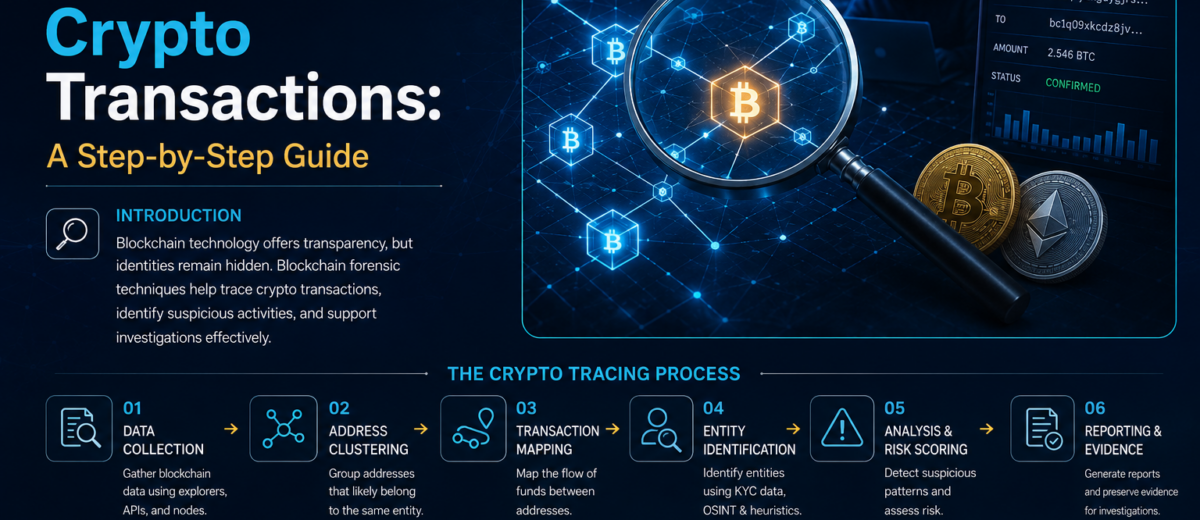
To trace crypto transactions, you begin with a piece of data: a wallet address, a transaction hash, an exchange deposit address, an interaction with a smart contract, etc. From there, investigators can follow each transaction to and from that address to understand how digital assets are being moved throughout the blockchain. As the investigation progresses, certain analytical techniques are used to find clusters of wallets that likely belong to the same entity. Investigators also investigate to see if the assets are connected to sanctioned centralized exchanges, decentralized finance protocols, NFT markets, cross-chain bridges or wallets. Investigators can often easily identify the companies or services associated with a certain wallet address by comparing the blockchain data with attribution databases and open-source intelligence. The findings are then presented in detailed forensic reports including transaction histories, diagrams of financial movements, wallet linkages and risk assessments. These reports can be used in civil litigation, criminal investigations, regulatory or internal corporate enquiries.
Common forensic techniques for blockchain
Modern blockchain investigations are not a single investigative approach but a set of sophisticated analytical approaches. Such tactics help investigators to reveal hidden relations between wallets and identify anomalous trends which can be an indication of fraud or money laundering. Some common methods include transaction graph analysis, grouping of wallets, attribution to entities, cross-chain transaction monitoring.
Steps of Investigation in Blockchain
Each investigation is performed in a methodical process to preserve evidence and accurately reconstruct the flow of digital assets.
Typical blockchain forensic investigations include:
1. Collecting wallet addresses, transaction hashes, and proof.
2. Validate the blockchain transactions on the relevant network.
3. Monitoring cryptocurrency transfers from one wallet to another.
4. Cluster related wallet addresses.
5. Where possible, assign wallets to known exchanges, businesses or services;
6. Assessing exposure to mixers, darknet markets, or other high-risk actors for sanctions.
7. Development of Investigation Results and Transaction Flowcharts.
8. Preparing a complete forensic report for legal, regulatory or commercial considerations
Blockchain Forensics Challenges
Blockchain technology gives transparency but the technical complexity of locating cryptocurrency transactions is considerable. Typically, criminal actors would seek to disguise the transfers of monies with mixers or other privacy enhancing equipment. They also use cross-chain bridges, decentralized exchanges, and many layers of intermediary wallets. Such tactics do tend to delay questions, but rarely make investigations impossible. Successful blockchain investigations consequently require not only advanced analytics tools but also competent investigators able to identify transaction patterns, correlate on-chain and off-chain data and grasp the legal and regulatory ramifications of their findings.
Who is Blockchain Forensics For?
A variety of businesses working in the digital assets and financial investigations space use blockchain forensics. Blockchain analytics are used by law enforcement authorities to investigate cybercrime, ransomware, fraud and money laundering. Cryptocurrency exchanges and financial institutions utilize forensic techniques to improve AML compliance and detect high risk transactions. Law firms, insolvency practitioners, cyber security organizations, corporate investigators and regulators are all also turning to blockchain forensics more to help support investigations and legal proceedings.
How Chain Trace Labs Assists Blockchain Investigations
Chain Trace Labs combines best-in-class blockchain analytics and investigative expertise to assist businesses in tracking digital assets, investigating fraud, monitoring wallet activity and ensuring regulatory compliance. Our systems cut through the complexities of blockchain investigations, transforming raw on-chain data into actionable intelligence. Whether you are assisting law enforcement, supporting legal professionals, conducting due diligence, or assisting victims of bitcoin fraud, we provide forensic reports that provide unambiguous, evidence-based analysis of blockchain transactions.
Frequently Asked Questions (FAQs)
1. Is blockchain confidential?
No. Most public blockchains aren’t anonymous, they’re pseudonymous. Wallet addresses are not personal identifiers themselves, but each transaction is forever recorded and may often be tied to real-world identities through forensic research .
2. Can stolen cryptocurrency be tracked?
Yeah. But generally the path of cryptocurrency transactions can be followed from wallet to wallet on public blockchains. The first stage in any recovery effort is often to follow the money trail, but the possibility of a recovery depends on a range of legal and practical difficulties.
3. What do you need to perform a blockchain investigation?
Investigators typically seek for wallet addresses, transaction hashes (TXID), information on blockchain network, screenshots of relevant transactions and any documentation available from the impacted party.
4. Which blockchains to research?
Blockchain forensic techniques can be used to study most of the public blockchain networks including Bitcoin, Ethereum, BNB Chain, Polygon, Tron, Solana, Avalanche, etc.
5. Are Blockchain forensic results admissible in court?
Yes. Such expert forensic studies may be used in civil litigation, arbitration, regulatory proceedings, or criminal investigations, providing they meet the evidentiary standards of the relevant jurisdiction.
Blockchain forensics is a must-have discipline for the digital asset ecosystem. The rising number of cryptocurrencies increases the importance of being able to trace transactions, uncover fraud and criminal activity, and assist in legal proceedings. While blockchain technology is inherently visible, it is blockchain forensics that turns that transparency into actionable intelligence to help organizations safeguard assets, manage compliance risks and pursue accountability in an increasingly digital financial ecosystem.