
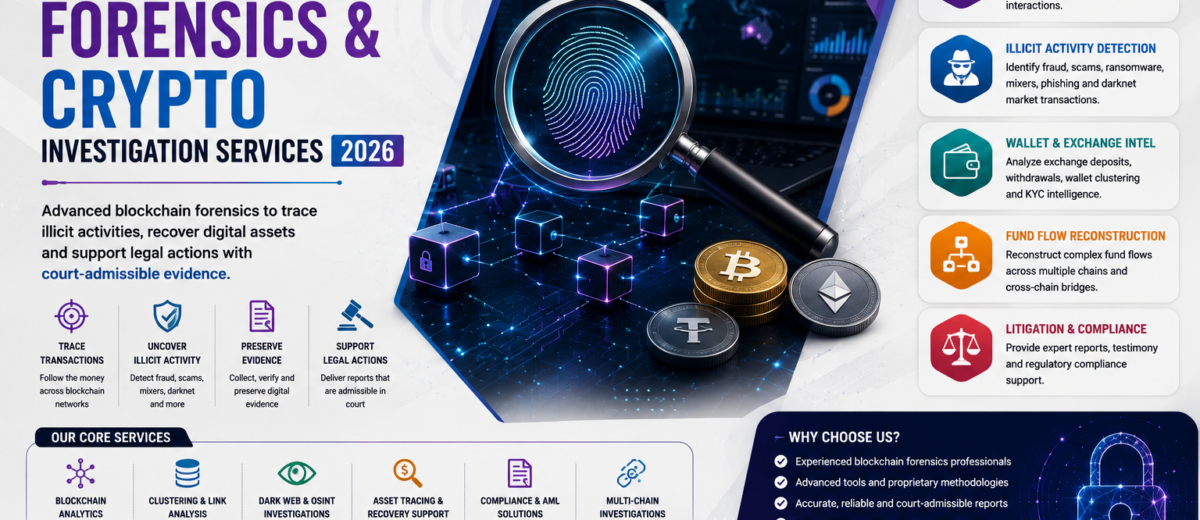
Blockchain forensics and crypto investigation services track stolen or suspicious digital possessions across public blockchains.However, detectives examine transaction histories; stolen money can be tracked via intricate webs and AI analysis can connect wallet addresses to actual entities. These specialised services assist victims, businesses and law enforcement in identifying cybercriminals, constructing legal proof and retrieving lost cryptocurrency.
Introduction
It used to be thought that cryptocurrency was totally anonymous and untraceable. On the other hand, every transaction ever made is permanently and irrevocably recorded by the underlying public ledger technology. Crypto crimes including ransomware attacks, phishing schemes, and hacking have expanded dramatically as the use of digital assets soars.
Legal experts, business owners, and individual investors must comprehend how cryptocurrency investigations operate. The transparency required to securely and effectively traverse the quickly evolving cryptocurrency world is provided by contemporary blockchain investigative approaches, such as the recovery of lost monies following a security breach or regulatory compliance.
Table of Contents
- How Blockchain Forensics Works to Track Stolen Crypto
- Core Services Offered by Crypto Investigation Agencies
- Comparison Table of Investigating methods used
- Example
- Common Mistakes
- FAQ
- Conclusion
How Blockchain Forensics Works to Track Stolen Crypto
The basic properties of distributed ledgers underlie blockchain forensics. All the details of a bitcoin transaction are the exact sender and recipient addresses, how much was transferred and when they are available publicly on the blockchain. Wallet addresses are not fully private, they are pseudo anonymous because they are random strings of characters and do not expose personal names.
Forensic experts tools analyze transaction patterns, clustering hundreds of individual wallet addresses together when they belong to the same entity or criminal organization. Algorithms built on artificial intelligence help investigators to automatically spot sophisticated money laundering techniques. Common tactics are peeling chains, where small amounts of crypto are repeatedly stripped off of a large sum, or passing assets thru decentralised cross chain bridges and mixers to hide their origin.
The key tipping point in any crypto investigation is when the funds move to a centralised crypto exchange or regulated fiat off-ramp. Centralised exchanges trade on Know Your Customer (KYC) rules for identity verification, with users uploading government ID cards, proof of address and selfie photos before they can trade or withdraw cash. Enforcement of law can issue formal legal subpoenas when forensic analysts are able to trace stolen funds to a wallet controlled by a centralised exchange. These court orders force the exchange to freeze the target account and disclose the personal identity details of the fraudster bridging digital crime to real world enforcement.
Core Services Offered by Crypto Investigation Agencies
Crypto investigation agencies offer a wide spectrum of professional services tailored for individuals, corporate entities and government institutions. Their primary service revolves around Asset Tracing and Recovery Support. When a victim suffers a scams or does unauthorized wallet drain, investigators construct detailed fund flow diagrams showing precisely where the stolen cryptocurrency moved across different chains. They generate court admissible forensic evidence reports that victims can submit to police, courts and financial regulators.
Another vital offering is Corporate Incident Response and Protocol Auditing. Web3 companies, decentralised finance protocols, and crypto exchanges hire forensic teams immediately after experiencing smart contract exploits or unauthorized system breaches. Investigators perform real-time threat monitoring, work to mitigate ongoing losses, and attempt to contact exchange compliance teams to freeze stolen assets before they are laundered.
In addition to reactive recovery agencies provide Proactive Anti Money Laundering (AML) Compliance and Risk Monitoring. Financial institutions and crypto businesses use these continuous monitoring services to screen incoming client wallets against sanctioned entity databases, darknet market listings, and terrorist financing lists. Businesses can remain compliant with global financial regulations and prevent illicit capital from entering their platforms by identifying high risk wallets before the transactions are completed. Certified forensic accountants play an important role in the court proceedings by assisting judges and juries to understand the complex blockchain evidence in legal disputes with their expert witness services.
Comparison Table
It summarises the 4 core methods used by crypto investigators and law enforcement to track down stolen or suspicious cryptocurrency:
| Method | Focus | Main Benefit | Key Challenges |
| Wallet Clustering | Groups linked wallet addresses | Uncovers hidden multi wallet address | Tough if the mixers are being used |
| Cross Chain Trading | Track funds across blockchains | Follows assets when swapped to other token | Complex multi chain pathways |
| Exchange Attribution | Links wallet to KYC exchanges | Enables account freezes and identity subpoenas | International Legal delays |
| Entity Tagging | Matches wallet to the real world data | Indentifies known hackers and darkness actors | Requires verified database tags |
How a phishing website drained a crypto investor’s Ethereum wallet of $50,000. The victim reached out to a blockchain forensics company right away. The stolen tokens were tracked by analysts thru three intermediary wallets and a decentralised cross chain bridge to a Bitcoin wallet. Using AI powered clustering, the software identified that the final destination was a deposit address at a major centralised crypto exchange. The investigation firm generated a certified report for law enforcement. Local police submitted an emergency court subpoena to the exchange which successfully froze the scammer’s account before the funds were withdrawn, allowing for legal asset recovery at crypto-investigation.
Expert Tip
If you fall victim to a crypto scam the speed becomes critical. Immediately log all wallet addresses, communication logs and transaction hashes. Never send any more money to “recovery agents” who ask for upfront fees on social media. No legitimate forensic company can ever guaranty the recovery of funds or ask for your private keys.
Common Mistakes When Recovering Crypto Assets
- Paying upfront fees to unreliable Telegram or Twitter agents who guaranty fund refunds is one way to fall for recovery scams.
- Not Preserving Evidence: Removing wallet addresses, phishing URLs, transaction hashes, or scammer chat logs that are required by law enforcement.
- Attackers using messaging facilitate direct communication with con artists and expedite the transfer of funds to obfuscation chains or privacy mixers.
- Exchanging Private Keys giving your private keys or seed phrase to “security experts” who are attempting to assist you.
FAQ
Can stolen cryptocurrency ever be recovered?
Yes, stolen cryptocurrency can be recovered, but it depends heavily on timing and fund destination. Forensic experts trace the movement of assets across the blockchain. If the stolen funds are deposited into a centralised exchange with Know Your Customer identity requirements, law enforcement can issue a subpoena to the exchange to freeze and legally seize the assets. But sending money thru decentralised mixers substantially lowers the chances of recovery.
What are the tools of blockchain forensic investigators?
Specialised investigators enterprise professional blockchain. These platforms collect massive amounts of on-chain data and then apply machine-learning algorithms to cluster wallets and cross-reference wallet addresses with known exchange infrastructure, darknet markets, sanctioned entities and criminal databases to reveal obscured paths of funds.
A forensic investigation can be done in how much time?
The duration of a crypto investigation depends entirely on the path stolen funds follow. Simple direct transfers to a centralised exchange can be mapped within 24 to 48 hours. However, complex cases involving multi chain bridges, privacy mixers and multiple international exchanges can take several weeks or months, especially when awaiting official law enforcement legal responses and court subpoenas.
Is blockchain tracing possible if scammers use privacy mixers?
Privacy mixers and privacy coins add a layer of obfuscation but modern forensic tools are usually able to break thru these. Advanced analytics re-identifies transaction paths thru time-volume correlations, liquidity entry pooling and deposit patterns. Scammers often trip up when cashing out of mixers into centralised exchanges, making it possible for forensic investigators to connect the dots again and identify high-risk accounts.
Why do police and law enforcement need private forensic companies?
Private crypto investigation companies generate court-admissible forensic reports to simplify on-chain evidence. This allows police officers, prosecutors and judges to easily understand fund movements and issue legal orders without the need for deep technical training.
How to identify a fake crypto recovery scam?
Social media is rife with fake recovery scams. Most fake recovery agents will contact victims directly, claiming to guaranty 100% fund recovery and requesting upfront payments in crypto or gift cards. Legitimate forensic firms do not guaranty asset recovery, do not ask for seed phrases or private keys and work thru verified business channels with transparent service contracts.
Conclusion
Blockchain forensics and crypto investigation services are disrupting the game of digital asset security by busting the myth of total cryptocurrency anonymity. Professional investigators may utilize artificial intelligence, advanced transaction mapping software and permanent public ledgers to effectively track stolen assets, expose money laundering networks and support criminal prosecutions.
As the technical possibilities of blockchain forensics progress, the single most decisive factor for recovering lost crypto assets will be speed. Victims of hacks or phishing scams should collect evidence immediately, contact official enforcement of law agencies and consult reputable forensic experts rather than succumb to social media recovery scams.
With digital currencies becoming more and more deeply embedded in global monetary systems, the importance of blockchain forensics in ensuring market integrity will become all the more vital. Investigation services use cutting edge technology and real world legal mechanisms to ensure that decentralised finance stays safe, transparent and accountable to legitimate users worldwide.